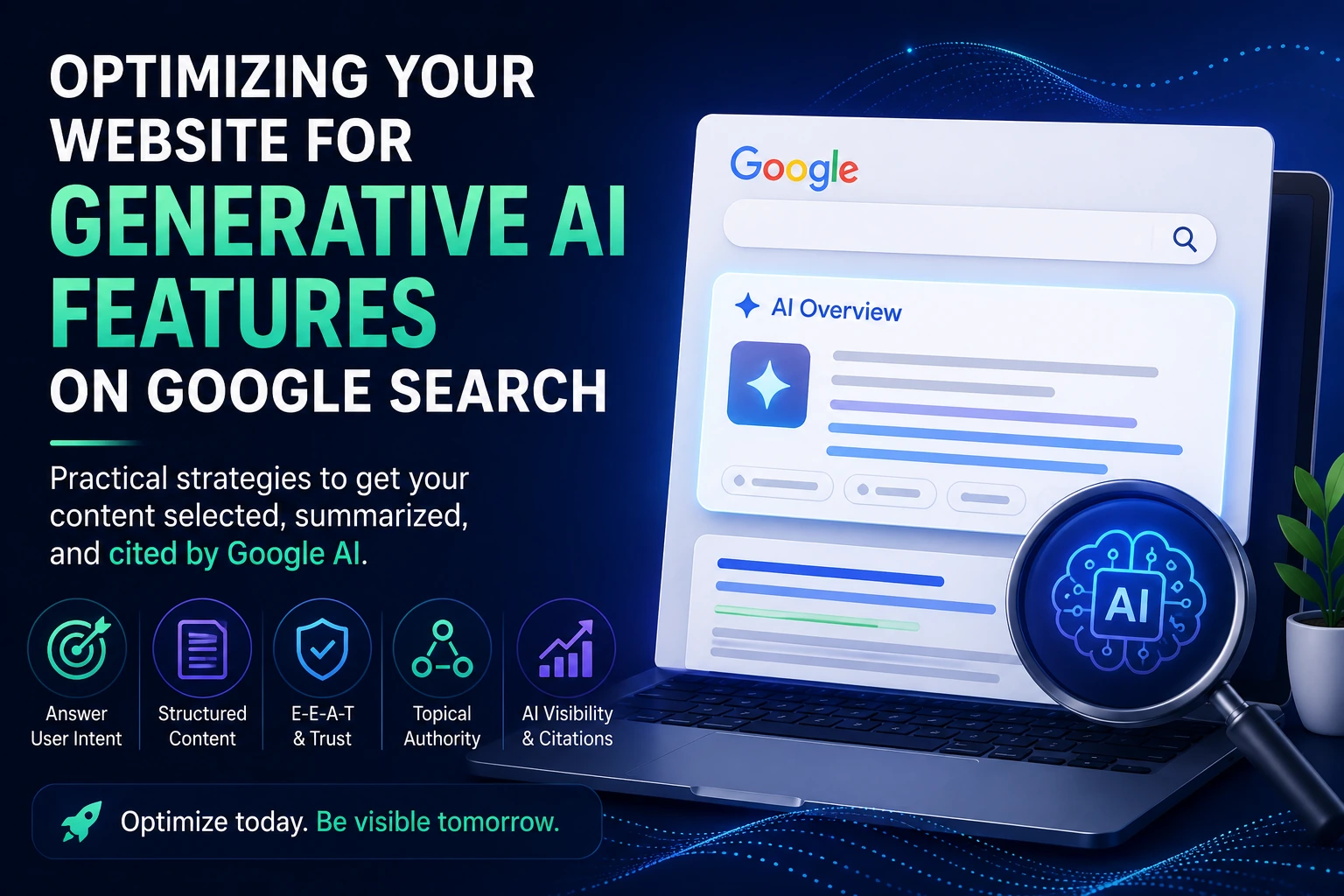
Google Search is evolving from a list of links into an answer engine. AI Overviews and conversational search experiences can combine information from several sources, explain a topic, and help users continue their research without starting a new query. That changes what website visibility can look like.
Traditional rankings still matter, but they are no longer the only opportunity. A useful page may also be summarized, referenced, or used as supporting context inside an AI-generated result. The practical objective is therefore broader than reaching position one: your content must be easy to discover, understand, trust, and quote accurately.
| Key idea: Do not optimize only for a keyword. Build a page that gives an AI system a clear, well-supported answer it can confidently connect to a user’s question. |
What Are Generative AI Features in Google Search?
Generative AI features are search experiences that create a synthesized response rather than displaying only a conventional list of results. Depending on the query and market, the experience may include:
AI-generated summaries that appear above or among standard results.
Links or citations to pages used as supporting sources.
Follow-up prompts that let users explore a topic conversationally.
Product, local, image, video, or shopping information blended into an answer.
Contextual explanations assembled from multiple webpages and data sources.
These features do not eliminate SEO. They make strong SEO foundations more valuable because a search system still needs to crawl a page, interpret its meaning, assess its usefulness, and connect it to an appropriate query.
How Google’s AI Systems Evaluate Content
No publisher can force an AI-generated result to include a particular page. However, websites can improve their eligibility by removing ambiguity and demonstrating genuine value. Strong candidates usually share several qualities:
The page directly satisfies the searcher’s intent.
Important facts and explanations are expressed clearly.
The content shows first-hand knowledge, expertise, or original analysis.
The website has a coherent subject focus and useful internal links.
Claims are supported by evidence, examples, or credible sources.
The page is technically accessible, indexable, fast, and usable on mobile devices.
The central question is simple: Can a person or machine quickly determine what this page is about, why it is credible, and which part contains the best answer?
1. Answer the Main Question Early
A long introduction that delays the answer creates friction. Place a concise response near the beginning of the page, then add the evidence, steps, examples, and nuance that make the answer useful.
Weak opening
“Search has changed considerably over the years, and many businesses are now considering new optimization methods…”
Stronger opening
“To improve visibility in Google’s generative AI features, make each important page crawlable, answer its main question immediately, support claims with evidence, and organize related content into a connected topic cluster.”
The stronger version gives the reader a usable answer while establishing the scope of the article. It is also easier to summarize without losing its meaning.
2. Structure Content for Fast Understanding
Clear structure helps readers scan a page and helps search systems identify relationships between ideas. Use headings as descriptive labels, not decorative phrases.
Use one clear H1 that matches the page’s central topic.
Use H2 headings for major questions or stages of the process.
Use H3 headings for examples, exceptions, and supporting details.
Keep paragraphs focused on one idea.
Use numbered steps for processes and bullets for grouped facts.
Use tables when readers need to compare options or diagnose a problem.
Avoid forcing every section into a rigid template. The format should match the information: a definition needs a concise explanation, a troubleshooting query needs diagnostic steps, and a comparison query needs clear criteria.
3. Match the Full Search Intent
Keyword use alone does not prove relevance. A page should solve the underlying task behind the query. Someone searching for generative AI optimization may need to understand the concept, evaluate priorities, implement changes, and measure the outcome.
Before writing, map the likely intent into four questions:
What is the reader trying to accomplish?
What must they understand before taking action?
Which practical steps will help them complete the task?
What concerns or follow-up questions are likely to appear next?
A page that answers only the surface keyword may rank briefly but fail to become a durable reference. A page that completes the reader’s journey is more useful in both standard and AI-assisted search.
4. Build Topical Authority With Connected Content
One broad article rarely establishes deep expertise. Build a focused cluster in which a central guide links to narrower supporting resources, and those resources link back to the guide and relevant commercial pages.
Example topic cluster
| Content role | Suggested page |
| Pillar guide | Generative AI Search Optimization: A Complete Guide |
| Supporting article | How Google AI Overviews Use Website Content |
| Supporting article | Why AI Search Does Not Mention Your Brand |
| Supporting article | How to Structure Content for AI Citations |
| Supporting article | AI Visibility Metrics You Can Track |
| Commercial page | Generative Engine Optimization Services |
This structure gives the website a clear topical map. Internal links should use descriptive anchor text and guide users toward the next useful resource rather than repeating the same exact keyword everywhere.
5. Increase Semantic Coverage Without Keyword Stuffing
Modern search systems evaluate concepts and relationships, not just repeated phrases. Cover the vocabulary a knowledgeable reader would expect while keeping the language natural.
For this topic, related concepts may include:
AI Overviews and conversational search.
Generative engine optimization and AI visibility.
Search intent, entities, and semantic relevance.
Crawlability, indexing, structured data, and internal links.
Source selection, citations, brand authority, and trust signals.
Do not insert terms simply to reach a density target. Add a related concept only when it improves the explanation or answers a realistic follow-up question.
6. Demonstrate Experience, Expertise, and Trust
Generic summaries are easy to produce and difficult to differentiate. Original evidence gives both users and search systems a reason to prefer your page.
Useful trust-building elements include:
A named author with a relevant biography.
First-hand examples from audits, campaigns, or experiments.
Original screenshots, diagrams, templates, or calculations.
A clear explanation of the method used to reach a conclusion.
Dates for publication and meaningful updates.
Transparent business information, editorial standards, and contact details.
References to primary sources when factual claims need support.
Authority is not created by writing “we are experts.” It is demonstrated through accurate explanations, transparent evidence, consistent identity, and useful contributions that other people can verify.
7. Add Original Information That Deserves to Be Cited
A page is more likely to earn attention when it contributes something beyond a rewritten summary of existing articles. You do not need a large research department to create original value.
Practical options include:
Publishing a small benchmark based on your own website or client data.
Comparing several approaches using a transparent scoring framework.
Documenting a before-and-after optimization process.
Creating an original checklist, diagnostic tool, or decision tree.
Interviewing a practitioner and summarizing the lessons.
Explaining where common advice fails in a specific industry or use case.
Originality does not mean inventing a contrarian opinion. It means adding evidence, experience, or synthesis that genuinely improves the reader’s understanding.
8. Use Structured Data Carefully
Structured data can help search engines understand the type and identity of content on a page. It should describe information that is actually visible to users and should never be treated as a substitute for strong content.
Depending on the page, relevant markup may include:
Article or BlogPosting markup for editorial content.
Organization or LocalBusiness markup for the company entity.
Person markup for authors or subject-matter experts.
Product markup for genuine product pages.
Breadcrumb markup for hierarchy and navigation.
FAQ markup only where the page and current search guidelines make it appropriate.
Validate the markup, keep names and identifiers consistent, and connect the website’s entities logically. Incorrect or misleading schema can create more confusion than clarity.
9. Protect the Technical SEO Foundation
AI visibility is impossible when the underlying page cannot be crawled, rendered, or indexed. Review the technical foundation before assuming a content problem.
| Area | What to check | Why it matters |
| Indexing | No accidental noindex directive; canonical points to the intended URL. | The page must be eligible for inclusion. |
| Crawling | Robots rules and server responses do not block important resources. | Search systems need access to the content. |
| Rendering | Primary text is available reliably and does not depend on fragile scripts. | Content must be interpretable after rendering. |
| Internal links | Important pages are linked from relevant, crawlable pages. | Links support discovery and context. |
| Performance | Core templates load quickly and remain stable on mobile. | A usable page supports engagement and access. |
| Sitemaps | Canonical URLs appear in an accurate XML sitemap. | Sitemaps aid discovery and maintenance. |
10. Optimize for Conversational and Follow-Up Queries
AI-assisted search encourages users to ask natural, detailed questions. A strong page anticipates the next step without wandering away from its main topic.
For example, a reader may begin with “How do I optimize for Google AI Overviews?” and then ask:
Does schema markup improve AI visibility?
Can a new website appear in an AI-generated answer?
How do I measure whether my brand is being cited?
Do backlinks still matter for generative search?
Should I create a new page or update an existing article?
Use these questions to shape subheadings, examples, and internal links. Do not inflate the article with unrelated topics simply because they are adjacent.
11. Design Pages for Multimodal Search
Generative search experiences can incorporate images, video, product information, and local details. Text remains important, but it should be supported by media that adds genuine explanatory value.
Use original diagrams to explain processes or relationships.
Give images descriptive file names and concise alternative text.
Add captions where an image needs context.
Create video transcripts or written summaries for important demonstrations.
Keep product and local information accurate and consistent across the site.
Avoid decorative media that slows the page without improving understanding. Every visual should help the reader learn, compare, verify, or act.
12. Keep Important Content Accurate and Current
Freshness does not mean changing the publication date every month. Update a page when the search experience, supporting evidence, product details, examples, or recommended process has materially changed.
A responsible update process includes:
Reviewing facts, screenshots, and external references.
Replacing outdated steps instead of merely appending new paragraphs.
Adding new examples or evidence where they improve the answer.
Removing sections that no longer serve the search intent.
Recording a meaningful update date when substantial changes are made.
How to Measure Generative AI Visibility
AI-generated search visibility is not captured perfectly by a single metric. Use a combination of indicators and compare trends over time.
| Signal | How to monitor it | What it can indicate |
| Search impressions | Review query and page trends in Search Console. | Whether Google increasingly associates the site with the topic. |
| Referral traffic | Track search and AI-assistant referrals in analytics. | Whether cited or linked visibility sends visits. |
| Citation sampling | Test a fixed set of realistic prompts on a schedule. | Whether the brand or page appears consistently. |
| Branded demand | Monitor branded queries, direct traffic, and assisted conversions. | Whether visibility is increasing awareness. |
| Content coverage | Audit which questions and entities the site answers well. | Where topical gaps remain. |
Do not judge progress from a single prompt. Results can vary by wording, location, context, and time. A repeated test set is more useful than occasional manual checks.
Generative AI Optimization Checklist
☐ The page has one clear purpose and matches a specific search intent.
☐ A direct answer appears near the beginning.
☐ Headings describe the actual questions and subtopics covered.
☐ Claims are supported by evidence, examples, or primary references.
☐ The article contains an original contribution rather than a generic summary.
☐ Relevant pages are connected through descriptive internal links.
☐ Author, company, and contact information are transparent.
☐ The URL is crawlable, indexable, canonical, and included in the sitemap.
☐ Images and other media improve understanding and have appropriate text alternatives.
☐ Structured data accurately represents visible content.
☐ The page is fast, stable, and usable on mobile devices.
☐ The content has an owner and a meaningful review schedule.
Common Mistakes to Avoid
Publishing mass-produced articles: Large quantities of shallow content create duplication and weak differentiation. Prioritize useful coverage over volume.
Hiding the answer behind a long introduction: Readers and search systems should not need to scan several screens to understand the main point.
Treating schema as a ranking shortcut: Markup can clarify content, but it cannot make a weak or misleading page trustworthy.
Creating isolated pages: A page with no meaningful internal links is harder to discover and place within the website’s topic structure.
Copying competitors: A rewritten version of existing results gives an AI system little reason to select your page.
Tracking only rankings: Measure impressions, citations, referrals, branded demand, and conversions alongside conventional positions.
Frequently Asked Questions
Is generative AI optimization different from SEO?
It is best understood as an extension of SEO. Crawlability, relevance, authority, usability, and strong content still matter, but the page must also be easy to interpret, summarize, and connect to conversational questions.
Can a small or new website appear in AI-generated results?
Yes, particularly for focused queries where the website offers a clear, credible, and distinctive answer. A smaller site can compete by covering a narrow topic deeply and contributing original evidence or experience.
Do backlinks still matter for AI visibility?
Links can support discovery, reputation, and authority, but they are not the only signal. Strong internal linking, entity clarity, useful content, credible references, and genuine mentions across the web also contribute to visibility.
How long does generative AI optimization take to work?
There is no fixed timetable. Results depend on indexing, competition, site quality, topic authority, and how quickly search systems reassess the page. Measure trends over several weeks or months rather than expecting immediate inclusion.
Should I create a new page or update an existing one?
Update an existing page when it already targets the same intent and has useful history or links. Create a new page when the new keyword represents a distinct task, audience, or search intent that would make the original page unfocused.
Final Thoughts
Optimizing for generative AI features is not a separate trick layered on top of SEO. It is a higher standard for clarity, usefulness, evidence, and technical accessibility.
The websites most likely to benefit are those that answer specific questions well, demonstrate real knowledge, organize related topics logically, and make every important page easy to discover and understand. Rankings remain valuable, but the wider objective is to become a trustworthy source that search systems can confidently use when constructing an answer.
Start with one important topic. Improve the best existing page, publish the missing supporting resources, connect them with internal links, and measure how search visibility changes. A focused body of genuinely useful content is more defensible than chasing every new AI-search tactic.
Optimizing Your Website for Generative AI Features: What You Need to Know
Optimizing your website for generative AI features means going beyond traditional keyword targeting. Google Search now creates synthesized responses that combine information from multiple sources, explain topics in full, and help users continue researching without starting a new query. To be visible inside these experiences, a page must be easy for both people and AI systems to discover, understand, trust, and quote accurately.
- Generative AI features produce synthesized answers, not just a conventional list of links — making clear, well-structured content more important than ever.
- AI Overviews can cite supporting sources, so a useful page may be summarized, referenced, or used as context inside an AI-generated result even without ranking at position one.
- Traditional SEO foundations remain essential because AI systems still need to crawl a page, interpret its meaning, assess its usefulness, and connect it to a relevant query.
- Content that demonstrates first-hand knowledge, expertise, or original analysis is a shared quality among strong candidates for inclusion in AI-generated responses.
- Technical accessibility matters: pages must be indexable, fast, and usable on mobile devices to remain eligible for generative AI features.
Does ranking on page one still matter for AI Overviews?
Traditional rankings still matter, but they are no longer the only opportunity. A page that directly satisfies searcher intent and expresses important facts clearly can be summarized or cited inside an AI-generated result regardless of its exact position in conventional results.
What makes a page a strong candidate for generative AI inclusion?
Google’s AI systems look for pages that directly satisfy the searcher’s intent, support claims with evidence or credible sources, maintain a coherent subject focus, and are technically sound. No publisher can guarantee inclusion, but removing ambiguity and demonstrating genuine value improves eligibility.
Leave a Reply