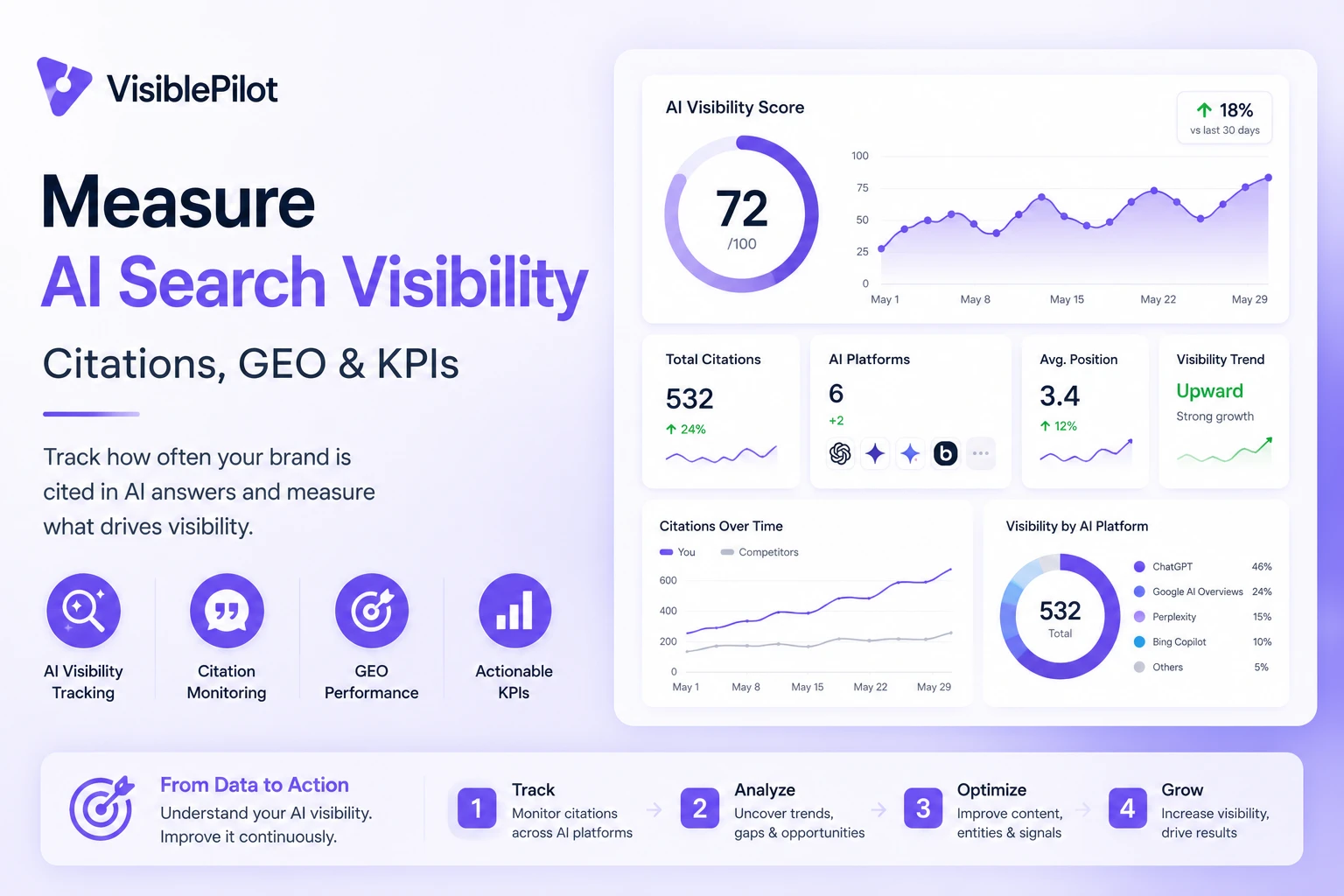
AI search visibility is not the same as traditional ranking visibility. A page can rank well in Google yet rarely appear in AI-generated answers. It can also be cited by an AI assistant without sending a measurable click. To evaluate performance properly, website owners need a reporting model that separates discovery, retrieval, citation, referral traffic and business outcomes.
The short answer
Measure AI search visibility with a scorecard that tracks: AI citations, unique cited pages, grounding queries, citation share, referral sessions, assisted conversions, content freshness and entity consistency. Do not use a single “AI visibility score” as your only KPI. The most reliable approach is to combine platform-reported citation data with repeated manual testing, analytics and conversion data.
What is AI search visibility?
AI search visibility describes how often and how prominently a brand, website, product or piece of content appears in AI-generated answers. These answers may be produced inside Google AI Overviews, Google AI Mode, Microsoft Copilot, Bing’s AI experiences, ChatGPT search, Perplexity and other answer engines.
Traditional SEO reporting usually focuses on rankings, impressions, clicks and organic conversions. GEO reporting must add another layer: whether an AI system can discover your content, retrieve it for a relevant question, trust it enough to use it, cite it visibly and influence a user’s next action.
Why rankings alone are no longer enough
Google states that established SEO best practices remain the foundation for appearing in its generative AI features. Microsoft makes a similar point: crawlability, indexing accuracy, internal links, content clarity and authority signals support both traditional search visibility and eligibility for Copilot grounding and citations.
However, good rankings do not guarantee AI citations. AI systems may retrieve several sources, combine facts across documents, prefer third-party evidence or answer a question without citing every source used. Citation patterns can also change when the wording of a prompt changes.
The AI visibility funnel
- Discovery: Can search engines and AI crawlers find the page?
- Indexing: Is the canonical page indexed and understood correctly?
- Retrieval: Is the page selected for relevant questions or grounding queries?
- Use: Does the model use facts, examples or recommendations from the page?
- Citation: Is the page shown as a visible source?
- Engagement: Does the citation generate visits, branded searches or return visits?
- Outcome: Does that visibility contribute to leads, sales or pipeline?
The 10 AI search visibility metrics that matter
1. Total AI citations
Total AI citations measure how many times your content is visibly referenced in supported AI answers. Bing Webmaster Tools now reports citation activity across Microsoft Copilot, AI-generated summaries in Bing and selected partner experiences.
Use it for: monitoring directional growth.
Do not treat it as: a ranking, traffic or authority score.
2. Unique cited pages
This shows how broadly AI visibility is distributed across your site. One highly cited page is useful, but a healthy content system should gradually increase the number of pages earning citations.
3. Grounding queries
Grounding queries are the phrases associated with the retrieval of your content for an AI answer. They reveal what topics and intents an AI system connects with your pages.
Review them for three things: relevant queries you already appear for, relevant queries where the wrong page appears and valuable query clusters where your site has no citation coverage.
4. Citation share
Citation share estimates your relative presence among the sources cited for a topic or grounding query. It is more meaningful than raw citations when overall query demand is rising or falling.
5. Prompt-level mention rate
Create a controlled list of commercially relevant prompts and test them repeatedly. Mention rate is the percentage of test runs in which your brand or page appears.
Formula: brand mentions ÷ total prompt runs × 100.
6. Prompt-level citation rate
A brand may be mentioned without a link. Citation rate tracks the percentage of prompt runs that produce a visible citation to your domain.
7. AI referral traffic
Track sessions from identifiable AI platforms in your analytics. Create a dedicated channel group for sources such as ChatGPT, Perplexity, Copilot and Gemini where referral data is available.
Remember that citation growth and referral growth may not move together. An AI answer can influence awareness without producing an immediate click.
8. AI-assisted conversions
Measure leads or sales where an identifiable AI referral appeared earlier in the user journey. Supplement analytics with customer surveys such as “How did you first hear about us?” because some AI-influenced journeys will appear as direct or branded organic traffic.
9. Entity consistency
Check whether your name, category, products, location, pricing model and key claims are described consistently across your website and authoritative third-party sources. Contradictory entity information makes accurate retrieval and recommendation harder.
10. Content freshness and evidence coverage
Track the percentage of priority pages reviewed within an appropriate freshness window and the percentage of important claims supported by current evidence, examples or original data.
A practical GEO measurement scorecard
| Measurement layer | Primary KPI | Supporting KPI | Review frequency |
|---|---|---|---|
| Technical eligibility | Indexed priority pages | Crawl errors, canonical errors, blocked resources | Weekly |
| Retrieval | Grounding query coverage | Relevant pages per query cluster | Monthly |
| Citation | Total citations | Unique cited pages and citation share | Weekly or monthly |
| Prompt testing | Mention rate | Citation rate and position in answer | Monthly |
| Traffic | AI referral sessions | Engagement and return visits | Monthly |
| Business impact | AI-attributed conversions | Assisted conversions and branded search lift | Monthly or quarterly |
| Content quality | Fresh priority pages | Evidence coverage and entity consistency | Monthly |
How to set up AI visibility tracking step by step
Step 1: Define your commercial query set
Start with 30 to 100 prompts grouped by intent. Include problem-aware questions, solution comparisons, category recommendations, brand comparisons, implementation questions and purchase-stage queries.
For example, a website visibility platform might monitor prompts such as “How can I improve my visibility in ChatGPT?”, “Best GEO tools for small businesses” and “Why is my brand not mentioned in AI answers?”
Step 2: Build a baseline
Run each prompt multiple times across the AI platforms important to your audience. Record the date, platform, model or mode, location where relevant, prompt wording, brand mention, cited URL, competitors cited and answer position.
Step 3: Connect platform data
Use Bing Webmaster Tools AI Performance for Microsoft citation data. Continue using Google Search Console for indexing, search queries, impressions and clicks because Google’s guidance says standard SEO foundations remain relevant to AI features.
Step 4: Create an AI traffic channel group
Group identifiable AI referrers in your analytics platform. Compare landing pages, engagement, conversion rate and assisted conversion behaviour against traditional organic search.
Step 5: Map citations to content changes
Maintain a change log for every priority page. Record updated claims, improved headings, new examples, added structured data, internal links, original research and third-party mentions. Compare citation and retrieval trends before and after the change, while avoiding claims of causation from a single observation.
How to improve the metrics
Make every important page easy to retrieve
Use descriptive titles, direct opening answers, clear H2 and H3 headings, concise definitions, tables, steps and FAQs. Build crawlable internal links from relevant pages. Submit canonical URLs through XML sitemaps and IndexNow where appropriate.
Publish information worth citing
Commodity summaries are easy to replace. Original data, documented processes, expert analysis, useful comparisons, first-hand examples and clearly sourced claims give an AI system stronger reasons to retrieve and cite a page.
Strengthen topical clusters
One isolated article rarely establishes complete subject coverage. Build connected clusters that answer the definition, diagnosis, strategy, implementation and measurement questions around a topic.
Useful supporting resources on the Visible Pilot Blog include generative engine optimization strategies for AI visibility, why ChatGPT may not mention your brand and how to optimize a website for Google’s generative AI features.
Fix technical visibility problems first
AI optimization cannot compensate for blocked crawling, duplicate URLs, accidental noindex tags, weak internal linking or pages that search engines cannot render. If visibility is poor across both search and AI answers, begin with a technical diagnosis. The guide on why a Shopify website may not appear on Google covers several common discovery and indexing failures.
Common AI visibility reporting mistakes
- Reporting one universal score: It hides whether the problem is discovery, retrieval, citation or conversion.
- Testing each prompt once: AI outputs vary, so repeated runs are necessary.
- Counting mentions as citations: A brand mention without a visible source link is a different outcome.
- Ignoring prompt intent: Informational, comparison and commercial prompts should be evaluated separately.
- Claiming causation too quickly: A citation increase after an edit may also reflect demand, freshness cycles or model changes.
- Optimizing only owned content: Third-party mentions, reviews and authoritative references can shape how an AI system understands a brand.
What a monthly AI visibility report should include
- Executive summary of citation, traffic and conversion changes
- Top gaining and declining cited pages
- Grounding query clusters gained or lost
- Prompt-level mention and citation rates by platform
- Competitor citation share for priority topics
- AI referral sessions and assisted conversions
- Technical issues affecting crawlability or indexing
- Content changes completed and next actions
Frequently asked questions
Can Google Search Console show AI Overview citations?
Google Search Console remains important for indexing, queries, impressions and clicks, but it should not be treated as a complete citation-level GEO reporting system. Use it alongside controlled prompt testing, analytics and any platform-specific AI reporting available.
Does an AI citation always produce a click?
No. A citation records visible source use, not a visit. Users may read the answer, remember the brand, search for it later or take no further action.
How often should AI prompts be tested?
Monthly testing is usually sufficient for a stable reporting program. Weekly testing may be useful during a launch, major content update or fast-moving news cycle. Always preserve the same baseline prompt set while adding separate experimental prompts.
What is the best GEO KPI?
There is no single best KPI. Use citations and citation share for visibility, grounding queries for topical relevance, referral and assisted conversion data for commercial impact, and technical metrics for eligibility.
Can structured data guarantee AI citations?
No. Accurate structured data can improve machine understanding and eligibility for supported search features, but it does not guarantee ranking, retrieval or citation. The markup must match visible page content.
Final takeaway
The goal of GEO measurement is not to produce a fashionable score. It is to identify where visibility breaks down and what action should follow. A useful system tells you whether a page is technically eligible, retrieved for the right questions, cited by the right platforms and connected to measurable business value.
Image prompts for this article
Featured image prompt: A premium editorial illustration of an AI search visibility dashboard showing citation nodes, search prompts, website pages and upward-trending analytics, clean SaaS aesthetic, dark navy and electric blue interface, subtle yellow highlights, realistic data visualization, no logos, minimal readable text, wide 16:9 composition, 1600 × 900.
Supporting image prompt 1: An information-flow diagram showing website discovery, indexing, AI retrieval, citation, referral traffic and conversion as a six-stage funnel, modern flat vector style, white background, clear iconography, professional SEO report aesthetic, wide landscape layout.
Supporting image prompt 2: A clean analytics scorecard for generative engine optimization with cards for total citations, cited pages, grounding queries, citation share, AI traffic and conversions, contemporary web app UI, high contrast, spacious grid, no brand logos, 4:3 composition.
SEO metadata
- Primary keyword: how to measure AI search visibility
- Secondary keywords: AI search visibility metrics, GEO KPIs, AI citations, grounding queries, measure generative engine optimization, AI referral traffic
- SEO title: How to Measure AI Search Visibility: GEO KPIs Guide
- Meta description: Learn how to measure AI search visibility using citations, grounding queries, citation share, AI traffic and GEO KPIs with a practical reporting framework.
- URL slug: measure-ai-search-visibility-citations-geo-kpis
- Suggested featured image alt text: AI search visibility dashboard showing citations, grounding queries and GEO performance metrics
- Suggested schema: Article and FAQPage
Leave a Reply