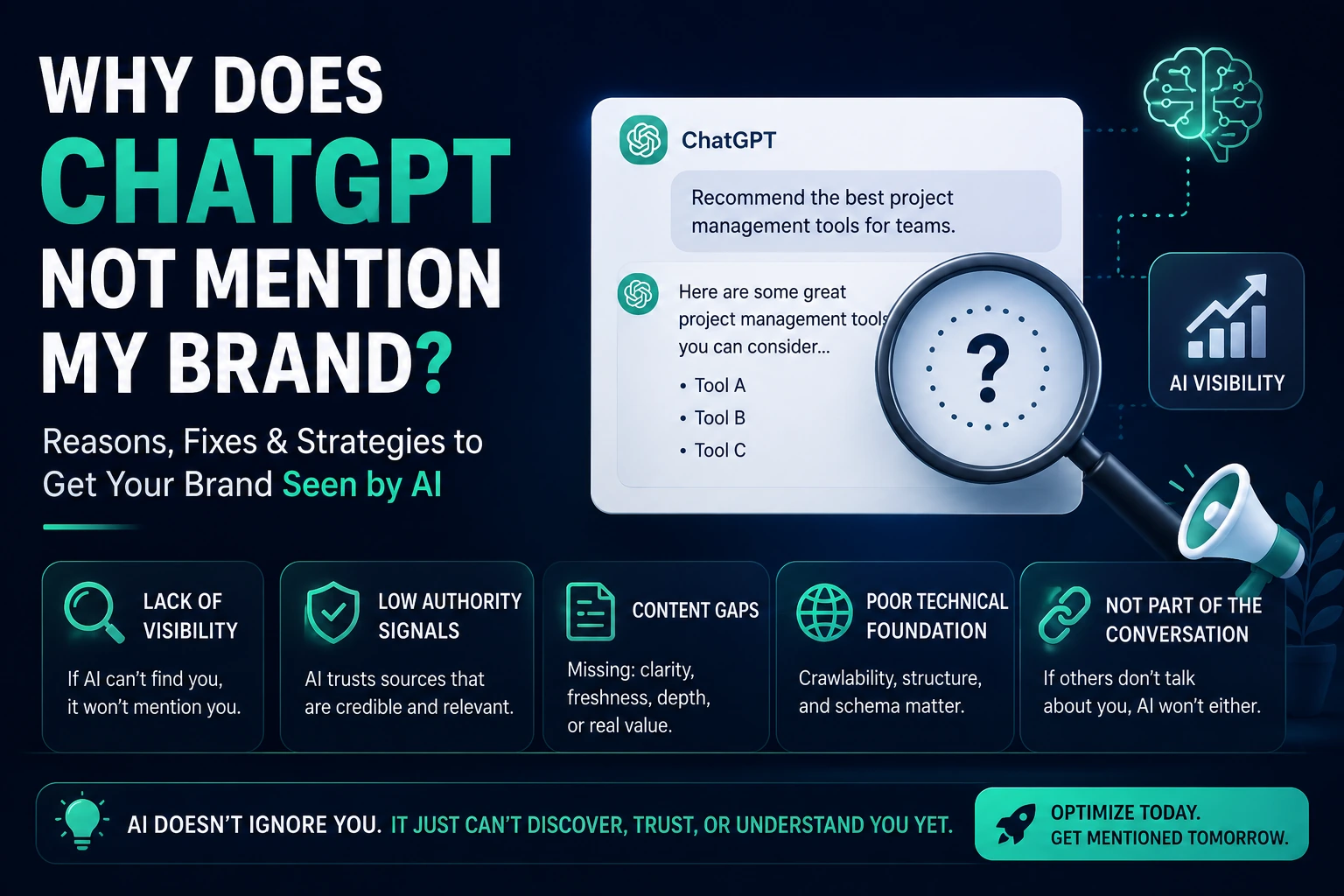
You ask ChatGPT for the best companies in your industry, the top tools for your niche, or the most recommended service providers in your city. Your competitors appear. Your brand does not.
That can feel personal, but it usually is not. In most cases, ChatGPT is not ignoring your brand because your business is bad. It is more likely that the system does not have enough clear, trusted, and relevant evidence to confidently connect your brand with the question being asked.
AI visibility is not the same as traditional SEO, but it overlaps with SEO. Your brand needs to be discoverable, understandable, trustworthy, and relevant to the exact prompts people are asking. When those signals are weak, vague, blocked, inconsistent, or too sales-focused, ChatGPT may choose another brand that is easier to verify and explain.
Quick answer
ChatGPT may not mention your brand because your website is hard to crawl, your brand is not clearly associated with your category, your content does not answer the questions users ask, your company lacks independent mentions, your product or service data is incomplete, or stronger competitors have more evidence across the web.
You cannot force ChatGPT to mention your brand in organic answers. What you can do is improve the probability by building stronger entity signals, making your pages accessible to AI search crawlers, publishing answer-led content, earning credible third-party mentions, and keeping your information consistent across your website, profiles, reviews, and product feeds.
ChatGPT does not mention every relevant brand
The first thing to understand is that ChatGPT is not a traditional directory. It does not list every business that could technically fit a query. When a user asks for recommendations, comparisons, or explanations, ChatGPT has to decide which names are most relevant, useful, and supportable in that context.
For ChatGPT Search, OpenAI says search results may be displayed when a user asks ChatGPT to search the web or when ChatGPT decides web search would help. OpenAI also says results are determined using language models and automated systems that consider factors such as user intent, relevance, and recency, with citations and sidebar sources used to support answers.
That means your brand needs more than a website. It needs a clear reason to be selected for a specific answer.
1. Your brand is not clearly connected to the category
A common reason ChatGPT does not mention a brand is simple: the brand is not easy to classify.
Your homepage may say things like “we help businesses grow” or “we create digital solutions,” but those phrases are too broad. An AI system needs clearer signals. It should be obvious what you sell, who you help, where you operate, and what problems you solve.
A stronger opening statement looks like this:
[Brand Name] is a [type of company] that helps [specific audience] achieve [specific outcome] in [location or market].
For example: “Visible Pilot is an SEO and digital marketing agency that helps Australian service businesses improve Google and AI search visibility.”
This kind of sentence gives search engines, AI systems, and humans a clean entity summary. It is not fancy, but it is useful.
2. Your website is not accessible to ChatGPT Search
If ChatGPT Search cannot access or understand your content, your chances of being mentioned drop. OpenAI says public websites can appear in ChatGPT search, but publishers should make sure they are not blocking OAI-SearchBot if they want content to be discovered, summarized, cited, and linked.
This is different from GPTBot. OpenAI’s crawler documentation explains that OAI-SearchBot is used for surfacing websites in ChatGPT search features, while GPTBot is related to crawling content that may be used for training generative AI foundation models. These controls are independent.
Check your robots.txt file. A simple allow rule may look like this:
User-agent: OAI-SearchBot
Allow: /
Also check your firewall, CDN, bot protection settings, and server logs. Sometimes the robots.txt file looks fine, but the server still blocks AI crawlers before they can fetch real pages.
3. Your content is written for Google keywords, not AI prompts
Traditional SEO often starts with keywords. AI visibility starts with questions, comparisons, use cases, and decisions.
A potential buyer may not ask ChatGPT for your exact service keyword. They may ask:
“What is the best CRM for a small real estate agency?”
“Which SEO agency is best for Shopify brands in Australia?”
“What are the best alternatives to [competitor]?”
“What should I use if I want a cheaper option than [popular tool]?”
“Who is good for local SEO but not too expensive?”
If your website only has sales pages and thin blog posts, there may be no content that answers these prompts. To earn AI visibility, create pages that explain when your brand is a good fit, when it is not, how it compares, what problems it solves, and what proof supports the claim.
4. Your brand has weak entity signals
An entity is a recognizable thing: a company, product, person, location, or concept. For ChatGPT to mention your brand confidently, your brand needs to be identifiable across the web.
Weak entity signals include inconsistent business names, missing About page details, different descriptions across profiles, no founder or team information, no clear address or service area, no schema markup, and no consistent social or directory profiles.
Strengthen your brand entity by making your core information consistent everywhere:
Brand name
Logo
Website URL
Business category
Founder or leadership names
Address or service area
Product or service descriptions
Social profiles
Review profiles
Press, podcasts, directories, and partner pages
The aim is not to spam the web with your name. The aim is to make your brand easy to recognize and verify.
5. You have too few independent mentions
Your own website matters, but it is not the only source. If only your website says you are one of the best options, that is a weak signal.
AI answers often lean on evidence that appears across multiple sources: reviews, directories, industry lists, comparison pages, marketplace profiles, partner websites, podcasts, interviews, case studies, and trusted publications.
This does not mean you need to buy backlinks. In fact, paid link schemes can create long-term SEO risk. Instead, focus on useful citations and legitimate mentions:
Get listed in relevant industry directories.
Ask partners to add you to their partner or vendor pages.
Publish case studies clients are comfortable sharing.
Appear on podcasts, webinars, and expert roundups.
Build review profiles on platforms your customers already use.
Contribute original data, templates, or research that others naturally reference.
The goal is to make third-party sources confirm what your own site claims.
6. Your pages are too generic to be cited
Generic content is hard for AI systems to use. If your article says the same thing as every other article, there is no strong reason to cite or mention your brand.
A page is more useful when it includes original experience. Add specifics such as:
Screenshots
Examples
Pricing ranges
Checklists
Templates
Pros and cons
Industry-specific advice
Before-and-after results
Clear explanations of who your service is and is not for
If you want ChatGPT to mention your brand for a category, your site should contain content that helps define that category better than competing pages.
7. Your competitors have stronger proof
Sometimes the answer is uncomfortable: competitors appear because they have stronger proof.
They may have more reviews, clearer positioning, better comparison content, more authoritative mentions, stronger product data, more recent content, better-known founders, or more third-party references. ChatGPT may also choose brands that users are more likely to recognize because they are easier to explain in a short answer.
This does not mean you cannot compete. It means you should stop asking, “Why did ChatGPT ignore me?” and start asking, “What evidence would make my brand the safest, most useful answer for this prompt?”
8. Your brand information is outdated or inconsistent
AI visibility can suffer when your business information is old or conflicting.
For example, your website says you serve ecommerce brands, your LinkedIn says you are a general marketing agency, your directory listing says you are a web design studio, and old posts still describe services you no longer offer. This creates uncertainty.
Update your high-value pages regularly. Make sure your About page, service pages, product pages, Google Business Profile, LinkedIn page, review platforms, and directory listings all describe the business in a consistent way.
9. You are targeting prompts that are too broad
A small or newer brand is unlikely to be mentioned for very broad prompts like “best marketing agencies” or “top ecommerce platforms.” Those queries are dominated by large brands and widely cited sources.
Start with narrower prompts where you have a stronger claim:
Best [service] for [industry]
Best [service] in [location]
Best [tool] for [specific use case]
[Competitor] alternatives for [audience]
Affordable [service] for [business type]
[Category] for Shopify brands
[Category] for small businesses in Australia
This is the AI visibility version of long-tail SEO. Own the narrow prompts first, then build toward broader categories.
10. Ecommerce brands may have product data gaps
If you sell products, brand visibility may depend heavily on product data. OpenAI’s merchant page says product discovery in ChatGPT can use product feeds and richer details such as images, pricing, reviews, availability, and current catalog information.
For ecommerce brands, improve the basics:
Product titles should be clear, not clever.
Product descriptions should explain use cases and differentiators.
Images should be high quality.
Pricing and availability should stay current.
Reviews should be visible and easy to understand.
Category pages should explain what type of shopper each product suits.
Product feeds should be complete and accurate.
If your products are vague, out of stock, missing descriptions, or poorly categorized, AI shopping recommendations may skip them.
How to diagnose your ChatGPT visibility problem
Run a simple AI visibility audit before changing everything.
Create a spreadsheet with 20 to 50 prompts your buyers might ask. Include informational prompts, comparison prompts, problem prompts, local prompts, and purchase-intent prompts. Then record whether ChatGPT mentions your brand, which competitors it mentions, which sources it cites, and what type of evidence seems to support the answer.
Use this audit to find patterns. If competitors are mentioned because they appear in directories, improve your directory presence. If ChatGPT cites comparison articles, create better comparison content. If it mentions brands with more reviews, improve review generation. If it cannot find your pages, fix crawl access.
A practical 30-day plan to improve AI visibility
You do not need to do everything at once. Start with the fundamentals.
Week 1: Fix discoverability. Check robots.txt, allow OAI-SearchBot if you want ChatGPT Search visibility, inspect crawl blocks, update your sitemap, and make sure key pages are indexable.
Week 2: Strengthen your brand entity. Rewrite your homepage positioning, improve your About page, add clear service or product descriptions, update schema, and make your profiles consistent.
Week 3: Publish answer-led content. Create articles for prompts like “best [service] for [audience],” “[competitor] alternatives,” “how to choose [category],” and “what to look for in [service].”
Week 4: Build external proof. Improve review profiles, update directories, request partner mentions, publish a case study, and pitch one expert contribution or interview.
Then repeat the audit monthly. AI visibility is not a one-time setting. It is the result of clear information, useful content, and trusted evidence compounding over time.
What not to do
Do not create fake reviews, fake awards, fake comparison pages, or low-quality directory spam. Do not publish hundreds of AI-written articles that say the same thing. Do not buy backlinks just to manipulate rankings. Do not claim to be the “best” without proof.
These shortcuts may create visibility for a moment, but they damage trust. AI systems are designed to compare evidence. If your evidence is thin, inconsistent, or manipulative, your brand becomes less useful to recommend.
The bottom line
ChatGPT does not mention your brand because it needs enough confidence to connect your brand with a user’s question. That confidence comes from crawl access, clear positioning, strong entity signals, useful content, consistent data, independent mentions, and real proof.
The fix is not to chase a loophole. The fix is to make your brand easier to understand, easier to verify, and easier to cite.
If you want to show up in AI answers, build the kind of web presence that makes your brand the obvious answer for a specific audience, problem, and use case.
Content Ideas to Support This Topic
| Content asset | Format | Example angle | Why it helps AI visibility |
| Brand entity page | Page | [Brand] is a [category] helping [audience] with [outcome]. | Clarifies who you are and what category you belong to. |
| Best for use-case article | Post | Best [service/tool] for [audience/use case] | Targets recommendation-style prompts. |
| Competitor alternative page | Post or page | Best [competitor] alternatives for [audience] | Gives AI systems a comparison source. |
| How to choose guide | Post | How to choose a [service/tool/company] | Captures research-stage prompts. |
| Pricing guide | Post | How much does [service/product] cost? | Answers high-intent commercial questions. |
| Case study | Page or post | How we helped [client type] achieve [result] | Adds proof that supports brand mentions. |
| FAQ hub | Page | Answers to common buyer questions | Creates concise answer blocks AI systems can use. |
AI Visibility Audit Template
| Prompt | Are we mentioned? | Who is mentioned? | Sources cited | What signal is missing? |
| Best [category] for [audience] | Yes / No | Competitor names | URLs cited | Reviews, comparison content, category clarity |
| [Competitor] alternatives | Yes / No | Competitor names | URLs cited | Alternative page, comparison data |
| Best [category] in [location] | Yes / No | Local competitors | URLs cited | Local proof, reviews, directory mentions |
| How to choose [category] | Yes / No | Advice sources | URLs cited | Educational guide, expert content |
| Affordable [category] for [audience] | Yes / No | Budget competitors | URLs cited | Pricing page, audience-specific page |
FAQs
Why Does ChatGPT Not Mention Your Brand in Answers?
Quick answer: ChatGPT does not mention every brand that could technically fit a query. When a user asks for the best companies in an industry, the top tools for a niche, or the most recommended service providers, ChatGPT selects names that are most relevant, useful, and supportable in that context. If your brand is missing from those answers, it is most likely because the system does not have enough clear, trusted, and relevant evidence to confidently connect your brand with the question being asked.
- It is not personal: In most cases, ChatGPT is not ignoring your brand because your business is bad — it is a signal problem, not a quality judgment.
- ChatGPT is not a directory: It does not list every eligible business; it selects names it can verify and explain with confidence given the available evidence.
- AI visibility overlaps with SEO but is not identical: Your brand needs to be discoverable, understandable, trustworthy, and relevant to the exact prompts people are asking.
- Weak signals are the core issue: When entity signals are vague, inconsistent, or too sales-focused, ChatGPT may choose a competitor that is easier to verify and explain.
- You cannot force inclusion: What you can do is improve the probability by building stronger entity signals, publishing answer-led content, and earning credible third-party mentions.
Does ChatGPT give the same brand recommendations to everyone?
No. ChatGPT considers factors such as user intent, relevance, and recency when forming answers. A brand that appears in one answer may not appear in another if the phrasing, context, or available evidence differs — which is why consistent, crawlable, category-clear content matters across every channel.
Why does ChatGPT mention competitors but not my brand?
Competitors that appear likely have stronger or more consistent evidence connecting them to the category being asked about. That evidence can include accessible web pages, independent third-party mentions, and content that directly answers the questions users are asking. Improving those signals is the most reliable path to changing that outcome.
Is this the same problem as not ranking on Google?
AI visibility is not the same as traditional SEO, but the two overlap significantly. Many of the signals that help a brand rank on Google — clear category association, credible external mentions, accessible and answer-led content — are the same signals that improve the likelihood of ChatGPT mentioning your brand.
Leave a Reply