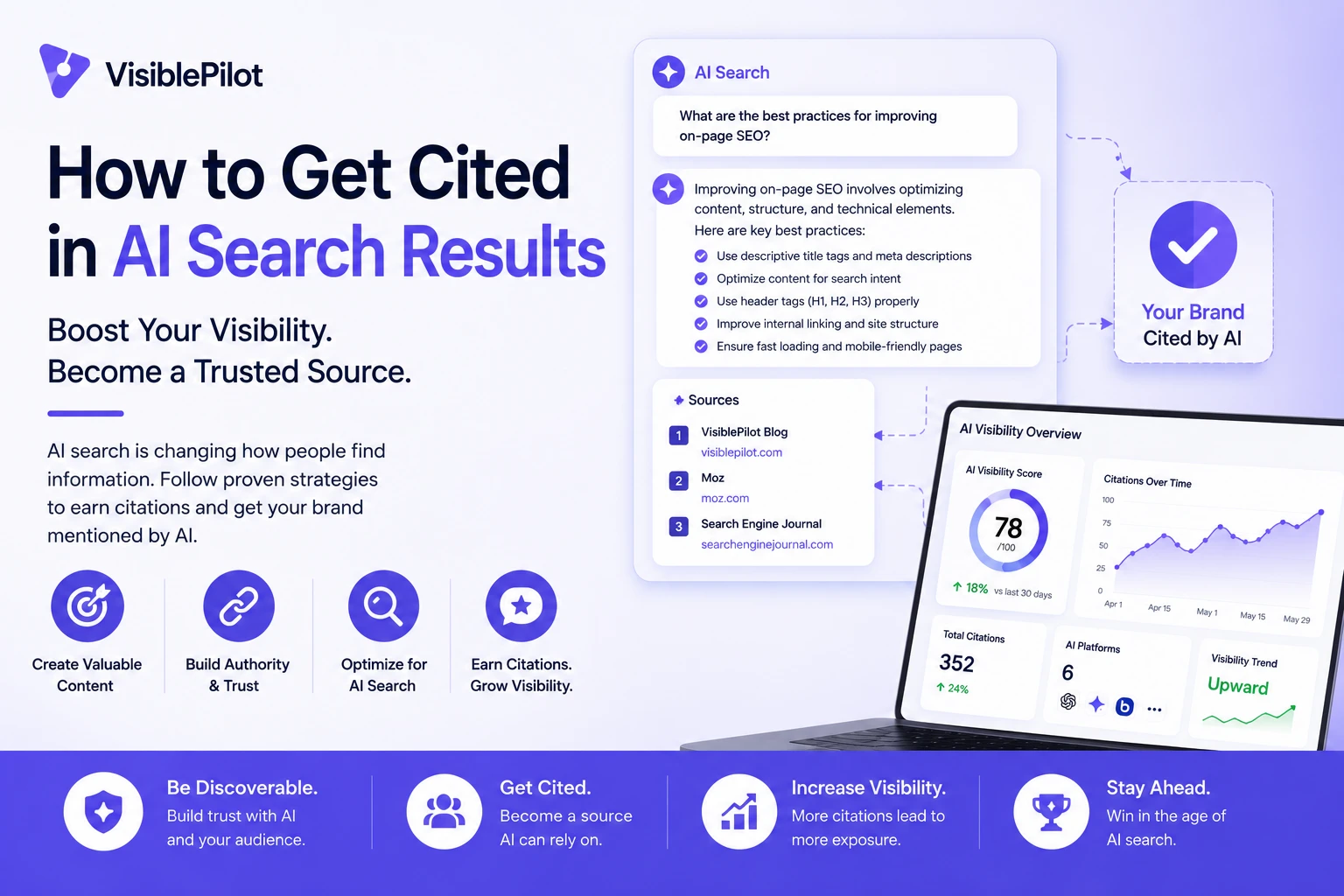
Ranking on Google is no longer the only way a website can earn visibility. Search experiences now generate direct answers, summaries, comparisons and recommendations—and many of those answers include citations to source pages.
That creates a new question for website owners: how do you make your content more likely to be selected as a source?
The answer is not to write for robots or repeat keywords more often. AI search citations are more likely when a page is technically accessible, clearly focused, easy to extract, supported by evidence and useful for the exact question being asked.
Quick answer
To improve your chances of being cited in AI search results, publish pages that answer specific questions directly, support important claims with reliable evidence, use clear headings and comparison formats, maintain accurate entity information, strengthen internal links and keep content technically crawlable and current.
There is no guaranteed method for earning a citation. Different AI systems use different retrieval, ranking and generation methods. Your goal is to make each important page a strong, trustworthy source that can be found, understood and reused without ambiguity.
What is an AI search citation?
An AI search citation is a visible reference or link that identifies a webpage as a source used to support a generated answer. Citations may appear beside a sentence, below an answer or inside a source panel, depending on the search platform.
A citation is different from a traditional organic ranking. A page may rank well but not be cited in a particular generated answer. Another page may be selected because it provides a more precise definition, clearer comparison, stronger evidence or more current information for the specific prompt.
| Traditional search result | AI search citation |
| A webpage appears as a ranked result | A webpage is referenced as evidence inside a generated answer |
| Usually evaluated at query level | May be selected for a particular claim or section of an answer |
| Success is measured with rankings, impressions and clicks | Success may include citations, brand mentions, referenced pages and assisted conversions |
| The user chooses which result to open | The AI system summarizes information before the user visits a source |
How AI systems choose pages to cite
There is no universal citation algorithm. However, most citation opportunities depend on four broad stages:
- Discovery: the system must be able to find and access the page.
- Retrieval: the page must appear relevant to the prompt or grounding query.
- Understanding: the system must be able to identify the page’s subject, entities and key claims.
- Selection: the content must be useful and trustworthy enough to support the generated answer.
This is why AI visibility still depends on strong SEO foundations. A page that is blocked, orphaned, duplicated or poorly structured creates friction before content quality can even be evaluated.
12 ways to make content more citation-worthy
1. Target a precise question or decision
Broad articles often contain too little depth on any single question. A stronger page has a clear job: define a concept, compare options, explain a process, diagnose a problem or help the reader make a decision.
For example, “AI search optimization” is broad. “How to measure citations in AI search results” is more precise. The second topic gives the page a clear retrieval purpose and makes it easier to match with a specific prompt.
2. Put the direct answer near the beginning
Do not make readers work through a long introduction before reaching the useful information. Give a concise answer first, then explain the conditions, evidence and practical steps.
A good opening answer usually states what the concept means, what matters most and what the reader should do next. This format helps people scan the page and creates a self-contained passage that can be understood without missing context.
3. Use headings that match real follow-up questions
Descriptive headings improve navigation and help separate the page into distinct answer units. Instead of vague headings such as “More details” or “Key factors,” use headings like “Does schema markup improve AI citations?” or “How often should citation-focused content be updated?”
Each section should answer the heading immediately. This makes the article useful for conversational searches where one initial question produces several follow-up questions.
4. Support factual claims with primary sources
Unsupported claims are difficult to trust and easy to replace. When you discuss search engine behaviour, platform features, standards, regulations or research findings, link to the original documentation or study whenever possible.
For example, Google explains that crawlable internal links and descriptive anchor text help it discover pages and understand their context. Microsoft now provides AI citation reporting in Bing Webmaster Tools, including cited pages and grounding queries. These are stronger foundations than repeating unverified advice from another marketing article.
Useful official references include Google’s link best practices, its Article structured data documentation, and Microsoft’s explanation of AI Performance in Bing Webmaster Tools.
5. Add original information competitors cannot copy easily
A page becomes more valuable when it contributes something beyond a generic summary. Original information may include first-hand tests, anonymized audit findings, customer questions, screenshots, templates, calculations, expert commentary or a documented process.
You do not need a large research budget. A small study of 20 websites can be more citation-worthy than a broad article that repeats common advice without evidence. Explain the methodology, limitations and date so readers can judge the result properly.
6. Make every important claim unambiguous
A sentence should identify who or what it refers to. Avoid unclear phrases such as “this tool,” “they say” or “it works better” when the reader cannot determine the subject, comparison or condition.
Use exact product names, dates, locations, units and definitions where they matter. Clear entity references help prevent a statement from being separated from the context needed to interpret it accurately.
7. Use tables for comparisons and decision criteria
Tables are useful when readers need to compare tools, tactics, costs, requirements or outcomes. They make relationships explicit and reduce the amount of interpretation required.
| Content format | Best use | Common mistake |
| Definition | Explaining a term quickly | Using jargon inside the definition |
| Comparison table | Helping users choose between options | Comparing inconsistent criteria |
| Step-by-step process | Explaining how to complete a task | Skipping prerequisites or decision points |
| Checklist | Auditing whether requirements are met | Listing actions without explaining priority |
| FAQ | Answering natural follow-up questions | Adding questions only to repeat keywords |
8. Strengthen internal links and topic relationships
Internal links help crawlers discover pages and help users move from a broad explanation to a more specific answer. Google recommends linking important pages from other relevant pages and using concise, descriptive anchor text.
For a deeper foundation, read our guide to generative engine optimization strategies. Website owners troubleshooting brand visibility should also review why ChatGPT may not mention a brand.
Avoid linking every occurrence of a keyword. Add a link when the destination gives the reader meaningful next-step information.
9. Prevent orphan pages and duplicate intent
A high-quality article can remain weak if no other page links to it. Orphan pages receive little internal context and may be harder for crawlers and users to find. Our guide to finding and fixing orphan pages explains how to detect and reconnect them.
Also avoid publishing several pages that answer the same question with only minor wording changes. Overlapping pages divide links, relevance and maintenance effort. Consolidate them or give each page a clearly different intent.
10. Use structured data accurately
Structured data can help search engines identify page types and attributes. For articles, relevant properties may include the headline, author, publication date, modification date and representative images.
Schema does not make weak content authoritative and does not guarantee a citation or rich result. It should accurately describe visible content rather than introduce claims that readers cannot see on the page.
11. Keep important pages current
Outdated facts reduce usefulness and trust. Review pages that contain prices, product capabilities, regulations, platform features, statistics or recommendations more frequently than evergreen definitions.
Update the visible content, not only the modification date. Record meaningful changes, replace obsolete sources and check that external and internal links still resolve correctly.
12. Make the page technically easy to access
Confirm that the preferred URL returns a successful response, is not unintentionally blocked, has the correct canonical, appears in a sitemap and can be reached through crawlable links. Important information should be available in rendered text rather than existing only inside an image or inaccessible script.
For ecommerce sites, technical visibility problems often affect product and collection pages at scale. The diagnostic steps in why a Shopify website may not appear on Google provide a useful starting point.
What does not guarantee an AI citation?
Several popular tactics are presented as shortcuts, but none creates a guaranteed citation.
- Adding an FAQ section: useful when it answers real questions, but ineffective when it repeats the article.
- Adding schema markup: helpful for machine understanding, but not a substitute for evidence or relevance.
- Increasing word count: more words do not automatically create more value.
- Repeating brand names and keywords: repetition can reduce readability without strengthening proof.
- Publishing large volumes of AI-generated content: scale does not compensate for duplication, weak sourcing or unclear intent.
- Blocking all crawlers except Google: this may prevent other search and answer systems from accessing your public content.
How to measure AI search citations
AI visibility measurement is still developing, so use several signals rather than one headline metric.
| Metric | What it tells you | Limitation |
| Citation count | How often supported platforms reference your domain or page | Does not always show prominence or influence |
| Cited pages | Which URLs are selected most frequently | A citation does not guarantee a visit |
| Grounding queries | Topics or phrases associated with retrieval | Reporting may be sampled or platform-specific |
| AI referral traffic | Visits sent from identifiable AI platforms | Some journeys may not pass clear referral data |
| Brand mentions | Whether the brand appears in relevant answers | Results can vary by wording, time and location |
| Conversions | Whether AI-assisted visits lead to business outcomes | Attribution may involve several channels |
Microsoft’s AI Performance report is especially useful because it exposes total citations, cited pages and grounding queries across supported experiences. Combine platform reporting with analytics, server logs, conversion tracking and a controlled set of recurring test prompts.
A practical AI citation optimization workflow
- Choose one valuable prompt cluster. Identify the main question and the follow-up questions a buyer is likely to ask.
- Audit the existing results. Review which source types are cited and what evidence or formats they provide.
- Select the best page. Improve an existing relevant page before creating a competing URL.
- Write the direct answer. State the core answer near the beginning and clarify important conditions.
- Add evidence. Include primary sources, original examples and transparent methodology.
- Improve extraction. Use descriptive headings, tables, steps and concise definitions.
- Confirm technical access. Check status codes, canonical signals, robots rules, sitemaps and rendered content.
- Add internal links. Link from relevant existing pages and link out to deeper supporting resources.
- Measure over time. Track citations, mentions, referral traffic and conversions rather than checking one prompt once.
- Refresh based on evidence. Improve weak sections, update facts and expand the page only where users need more help.
Frequently asked questions
Can a new website get cited in AI search?
Yes, but a new website usually has fewer authority and entity signals. It can compete by targeting narrow questions, publishing genuinely original information, earning relevant third-party mentions and making each page technically accessible and easy to verify.
Does ranking first on Google guarantee an AI citation?
No. Strong rankings may improve discoverability, but generated answers can cite several sources and may select a page that better supports a specific claim, comparison or recent fact.
Does schema markup improve AI visibility?
Accurate structured data can clarify page type and entity attributes, but it does not guarantee inclusion. It works best as part of a broader strategy involving crawlability, helpful content, evidence, internal links and consistent entity information.
How long does it take to earn AI citations?
There is no fixed timeline. Discovery, indexing, source selection and reporting differ by platform. Technical changes may be discovered relatively quickly, while authority, third-party mentions and stable citation patterns usually take longer to develop.
Should every blog post be optimized for AI citations?
Every post should be clear and useful, but not every page needs to target a citation opportunity. Prioritize pages that answer valuable questions, contain distinctive evidence or support an important customer decision.
Final takeaway
The most reliable way to improve AI citation potential is to become a better source. Make your content accessible, precise, well structured, evidence-led and current. Build clear relationships between related pages, remove duplication and publish information that adds something genuinely useful to the web.
Visible Pilot is being built to help website owners identify, prioritize and safely complete SEO and GEO improvements across their sites. The principle remains the same whether the work is manual or automated: visibility improves when search systems can confidently find, understand and trust the right page.